Monday, 21 March 2016

VFX Pipeline

VFX Pipeline


1) Research and Development - this plays a key role in the vfx pipeline because the R & D team can be crucial for being able to manipulate the newer more advanced tools to make a movie stand out, there is also a saying you can never have to much information. 
2) Tests - These are vital to get funding for a film. They usually require a team of skilled artists to get the tests done on short notice to show the client that their vision can become a reality and give them confidence

3) Pre-Vis - This is where you do a rough layout of your scene in software (such as Maya) to plan out and get a grasp of what your going for and where everything should be. A good example is the Lord of the Rings Pre-Vis for the Mines of Moria scene.
4) Modelling - this is needed to turn clients sketches and real life models into fully functional high res CG characters. Another role of modeling is to have each asset modeled at different quality levels high for final render, medium for animation and low for Pre-Vis.
5) LIDAR (Light and Radar) - A Lidar is a laser based 3D scanning device that can make some really realistic looking models for environments and buildings smaller models will use a similar machine as well.

6) Film Scans - This is the function of getting footage from a film reel, many movies use this Each frame is scanned as a separate high dynamic range image to preserve as much detail as possible.

7) Grading - The purpose of grading is to make sure all the shots look the same and have the same "feel" so there are no sudden jumps in brightness or colour. This is done using colour and exposure changes.

8) Plate Preparation - in filming it is almost impossible to get a 100% clean film, so there are dust spots and chemical patches on the scans. because of this a team of compositors go through and paint out any scratches or dust that appears in the scans this has been referred to as "Dust Busting".

9) Rigging - Rigging is used to create a skeleton for a model or character. This makes it a lot easier to animate as you can move the bone structure in a more natural way rather than moving the faces frame by frame. We haven’t delved into this topic and it most likely will not be applied to our scene, however I would like to learn how to do it for when it comes to games design.
10) Look Development - This is where you take the time to get the shot exactly how you want it and to make sure that it fits the rest of the scene. For the most part we got the right angles that we could get for our shots in the time given, however if we had more time it would be improved.
11) Lighting and Rendering - Lighting and Rendering is where you make sure that the light in the scene is in the right position and is hitting the right objects. For example you would prefer to have the light shining on a more focused area of the scene than anywhere else.

12) Texturing - Texturing is the process of making sure that all of your models in your scene look like they belong there and look high quality. In films like the Avengers all of the destructible wall will have to be well textured and nicely rendered. This can be done in a software such as 3DS Max.
13) Tracking - Tracking is used in various kinds of shots, for example it is used on faces if they are going to be later replaced by a CGI face such as Colossus out of Deadpool. However it can also be used to make an object still in a shot.

14) Effects Animation - Is used to create various kinds of effects ranging from dust to water, etc. I think that this would really fit the scene as the runner speeds past the screen. This would also give the viewer a more immersive experience.
15) Rotoscoping -  unlike in animation, VFX rotoscoping used to create a  mask for an element so it can be extracted out to be placed on a different background. i have not yet got round to trying this, however it would fit our scene very much so if we were to change the story a bit to suit it.

16) Elemental Shoot - An Elemental shoot is where you record various elements that can be used in your scene, for example fire. Fire is used loads throughout films whether its on the end of a torch or a car engine on fire. We haven’t applied this thus far as it is our first shoot and we went quite strict on the risk assessment because of this.

17) composition - compositing is the last process that the the VFX pipeline goes through it is adding all the CG, elements and scanned plates as well as matte paintings. The compositer will use a variety of techniques to intergrate everything together.


use in the production of actual sequences on the film. Tests are done as proof-of-concept pieces to give the client confidence that what they want to achieve is possible. Tests are generally done by very experienced artists as they are often highly experimental and complicated with tools needing to be written on the fly by the team doing the test. Once the work is won the process of building the models can begin

Thursday, 17 March 2016

12 Principles of Animation


In Animation there is so much you can do, your imagination is boundless but within animation there is 12 principles. Each principle is as important as the next and is universally accepted in animation.
        The people who came up with the 12 principles originally worked for Disney known as "the grumpy old men", although at the time they were young and making new techniques for an early art form.
1. Squash and stretch - this is distorting shapes and exaggerating movements, good for movement like sneaking and to show emotion in facial expression.
2. Anticipation - An action that tells the viewer what will happen next such as a baseball player pitching a ball or an archer knocking back an arrow.


3. Staging - present your ideas so it makes sense (this relies heavily on timing) and conveys a message, using an action to create a mood or storyline.
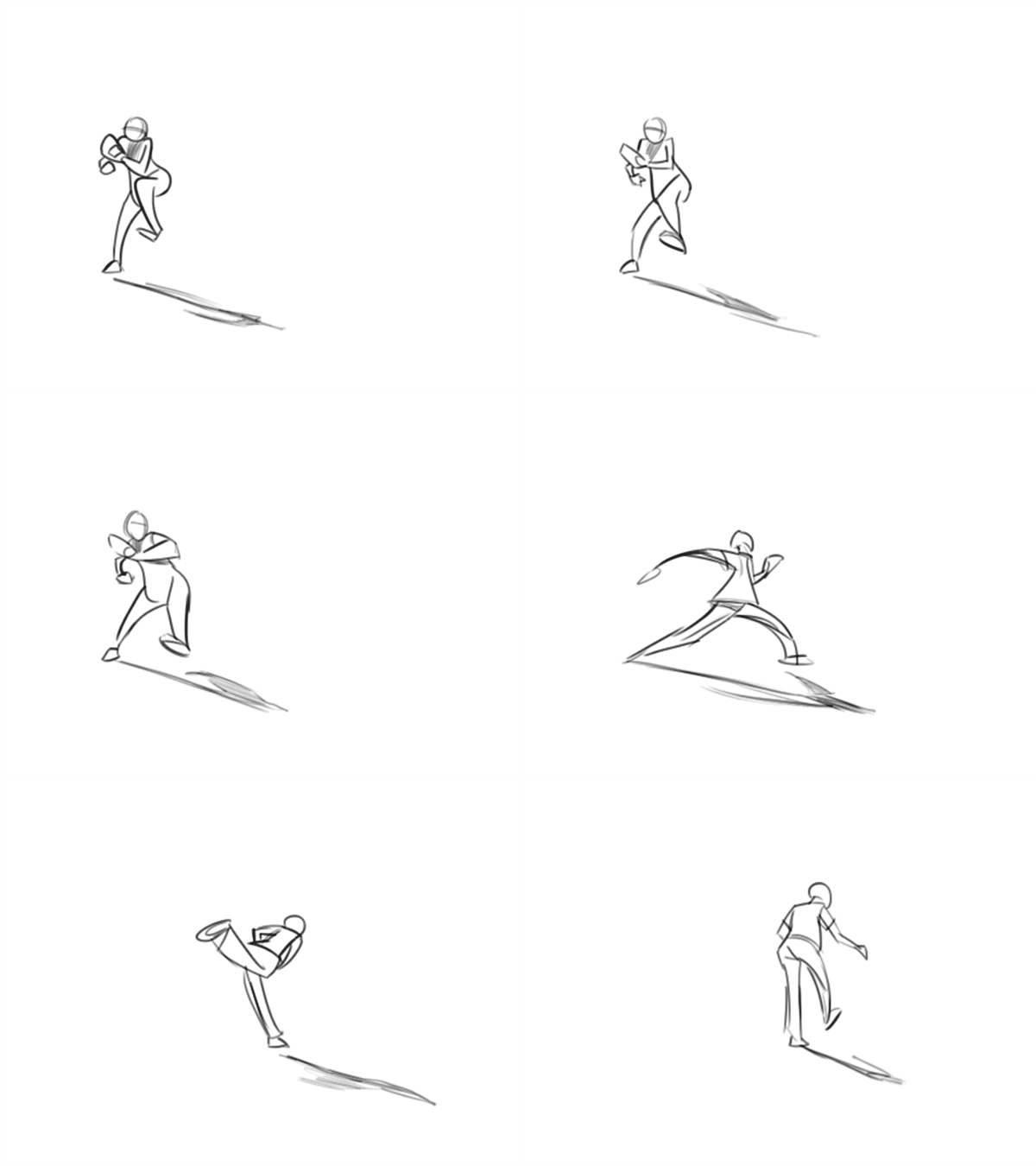
4. Straight Ahead - animating each frame in order. (pose to pose) Which leads to great looking, stylized animation an example of this is below, you would use pose to pose to make it look as fluid as possible.
5. Follow through and overlapping action - this is mostly used for limbs, clothing and other attributes. it is based on how in physics stuff doesn't just stop dead in its tracks, actions and attributes continue and overlap into the next action.
6. Slow in and Slow out - objects speed up and slow down as the animation plays, this is in day/night cycle curves. and is also used to show when physics are taking effect such as slowing at the peak of a jump.

7. Arcs - An Arc often relies on ease in and ease out, it is an action that follows a circular path, it is most effective in human and animal movements.

8. Secondary animation - Extra little bits of animation, which support the main movement/ animation. These are often hands, legs and facial features.

9. Timing - Number of frames between movement, with low frames the animation looks fast and with more frames the animation looks slower and more precise. Timing is useful for giving texture and interest in a movement using more or less frames and is good for making something faster that would of been tedious.

10 - Exaggeration - pushing movements and poses to extremes. makes more of an impact and draws attention to that animation. Such as bugs bunny when he is in love it draws attention by making it look like his heart is gonna burst.

11. Solid drawing -  More relevant in 2D animation design characters with a 3D form, giving it weight and volume to create the illusion of a 3D object.

12. Appeal - Making animation interesting to the viewer, designing characters to attract the viewer, this is most relatable to DC and Marvel comic animations as everyone appeals to the superhero but most of the time the villain looks cooler because he is made to appeal to the audience.

Friday, 11 March 2016

Easter Game - Eggs

I have volunteered for an Easter game for the college, in which a rabbit maneuvers around a level collecting good eggs and avoiding bad eggs.
          So far everything is going swimmingly except that we need more egg variations, a new catchier name and an instructions screen. For the name I haven't got past anything better than Hopsy's Eggcelent Adventure but i suppose it will have to do for now.
      For the eggs i have uploaded 5 new skins, The first being more unique than the rest is "Limbegg"

We needed to create egg skins as every 5 eggs a random egg appears in our game to keep our audience enthralled in it.

Inspiration from limbo the critically acclaimed platformer.

These I named the "Castle Crasheggs"


" Spidegg Man"


"Sunderlegg"
"Newcastlegg"(Bad Egg)

I had a lot of fun making these eggs its amusing enough just coming up with the puns.

with the instructions screen owan and izzy worked together to come up with this finished product which clearly illustrates how to play the game:

Monday, 1 February 2016

Guardians of the Galaxy - VFX


 I recently watched Guardians of the Galaxy, personally i thought it was a great film and as an added bonus it had heaps and heaps of visual effects to go with it.    
My favourite character was of course Groot the loveable tough Ent-like creature that acted as muscle for his furry friend Rocket, all the way through the film Groot had multiple scenes with great VFX from something as simple lighting up a cave to him incasing his friends in a wooden protective sphere when they were in great danger.
The storyline is a little bit weird but it runs pretty smoothly but i wasn't too interested in that aspect. What was a truly great was the BIG VFX scenes which must have had so much effort put into them such as in the Nova Corps blockade scene that was truly awesome where they create a seemingly impenetrable barrier with all their ships or the Xandar Orb chase scene as they would need to choreograph Rocket and Groot into it while making it still look smooth both very well executed scenes.
Here you can watch the full fight scene on youtube at:  https://www.youtube.com/watch?v=YlyPxpLraaA 
Not one of the best films in some departments but if you like lots of action and some jaw dropping VFX i'd give it a watch.


Friday, 29 January 2016

Rodeo - Visual Effects Company

From taking over the reigns from Screen Scene VFX with Game of Thrones, to helping with such great films as Lucy, Inception and Edge of Tommorow Rodeo has come a long way from when it was formed in 2006. 
With 300 "accomplished visual effects professionals" they have contributed to over 50 films, that's an average of 5 films a year! The company covers all aspects of VFX from building sci-fi cities to creating realisitic storms and waterfalls Rodeo do it all.
The President of the company is Sebastien Moreau who takes pride in Rodeo as he and his team have gone out of their way to make it 1 of the best VFX companies in the world with a LONG list of notable clients and a well recruited team of experts Rodeo excels in VFX.

Tuesday, 26 January 2016

Environment drawing

In College we were assigned to do thumbnails for an environment of our choosing. I decided to try thumbnails for an overgrown or abandoned urban area. I took inspiration from games such as "The Last of Us"  and "I Am Alive" but wanted to make my pictures diverse so i got some inspiration from films such as "The Road" and "I Am Legend" aswell.

I was taught that thumbnails are quick sketches usually not too big but show some detail, you create a few to show different views of what your drawing. They are important in the industries because you can quickly show your idea  to give a good impression of what you want to make and it helps other people by making their jobs easier if they are going off a sketch and not their own idea.
Above is a drawing I completed on the graphics tablets we have been using, I have chosen an abandoned urban theme for my work and I have to say they make drawing so much easier and also more enjoyable because you can pretty much never make a mistake so you just relax and make art

Saturday, 23 January 2016

VFX Timeline


VFX compared to most things has a relatively short timeline, this is because it is a pretty new way of making film. 

The first milestone for VFX was Bound for Glory (1976) because they used the first steady-cam which made a huge change in the film industry as the user had so much more control and stability when using the camera

Made by Garret Brown Filmmaker and inventor, as seen Below. 

. 


The next Milestone is Star Wars (1977) as the quality of the special and visual effects really raised the bar, and saw the creation of George Lucas own Industrial Light and Magic who lead the way into the new industry of VFX.
When Superman (1978) was being filmed the invention of the Zoptic system came about, which when used gave the illusion of a man flying so was hugely successful for Superman.
         The way it worked was by combining foreground performance with pre-filmed background footage to create the flying effect.
A huge milestone for the VFX industry was Star Trek The Wrath of Khan (1982) this is because it involved the first fully CGI scene. The people who made this then went on to form Pixar and be hugely successful.


After the First fully CGI scene there came the first hard-bodied CGI character in Young Sherlock Holmes (1982). made by ILM and what would go on to be Pixar, The stained glass knight was a marvel to behold in the visual effects world.
Not too long after that there came the first fully CGI soft-bodied character. This appeared in The Abyss (1985) when making the N.T.I (evil water monster), I think it still holds up by today's standards pretty well seeing as its 25 years old.
Another Milestone for VFX was in Terminator 2 Judgement day (1991). The VFX artists used a digital imaging software which was an early form of photoshop, this probably payed tribute to photoshops success.
The final milestone in the VFX timeline is Jurrasic Park (1993) in which they were the first to use fully CGI animals, strangely enough there were much more scenes using animatronics and "special effects" than using visual effects, this demonstrates that VFX and SFX should go hand in hand when making a films.
Visual effects has come so far in such little time and it's amazing looking at where we started and what we can manage to achieve today, with films such as Lucy, Inception and X-men days of future past I can only dream of what comes next. All I know is I can't wait!